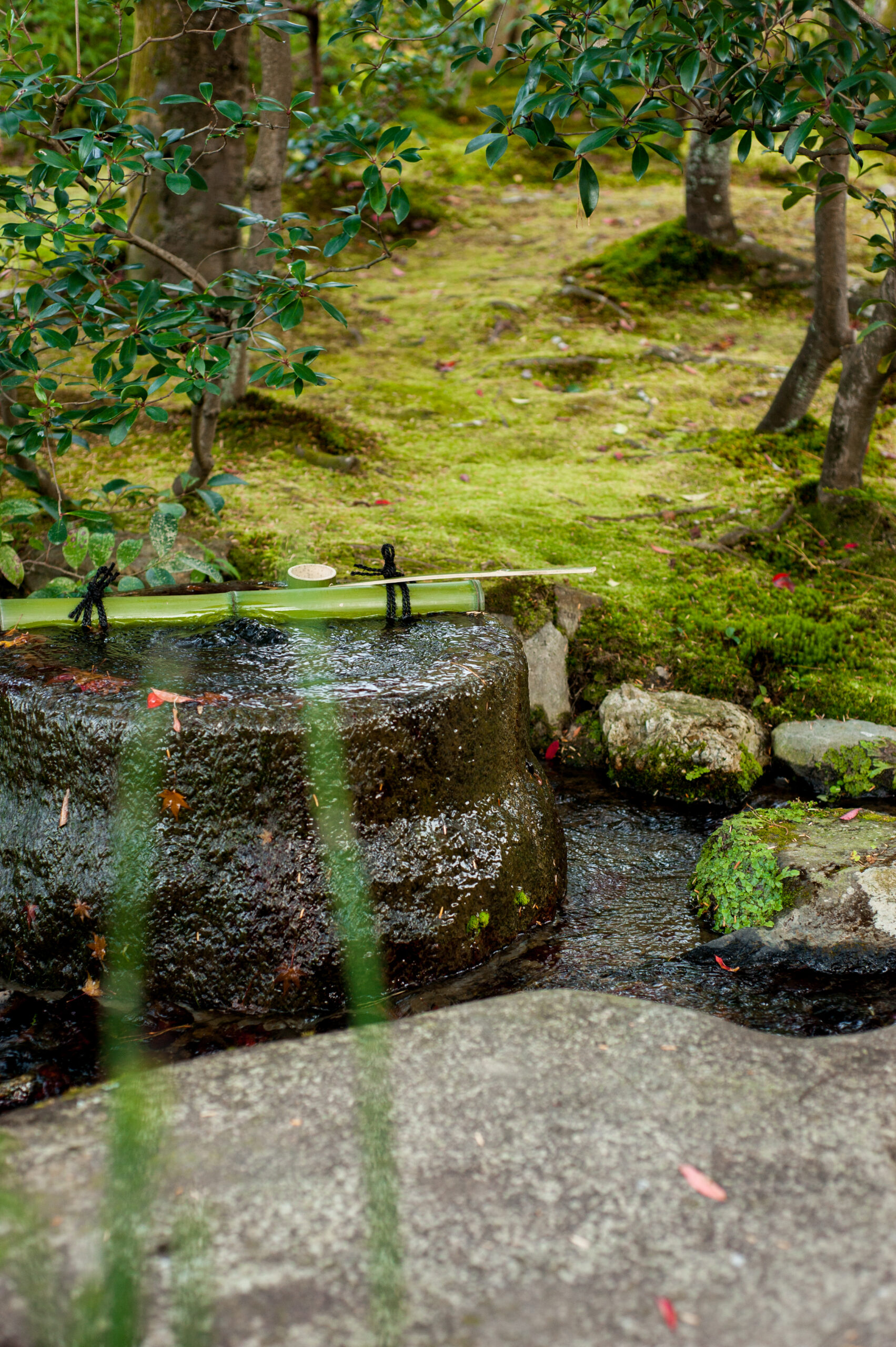
The Basin Stone and Basin Arrangement
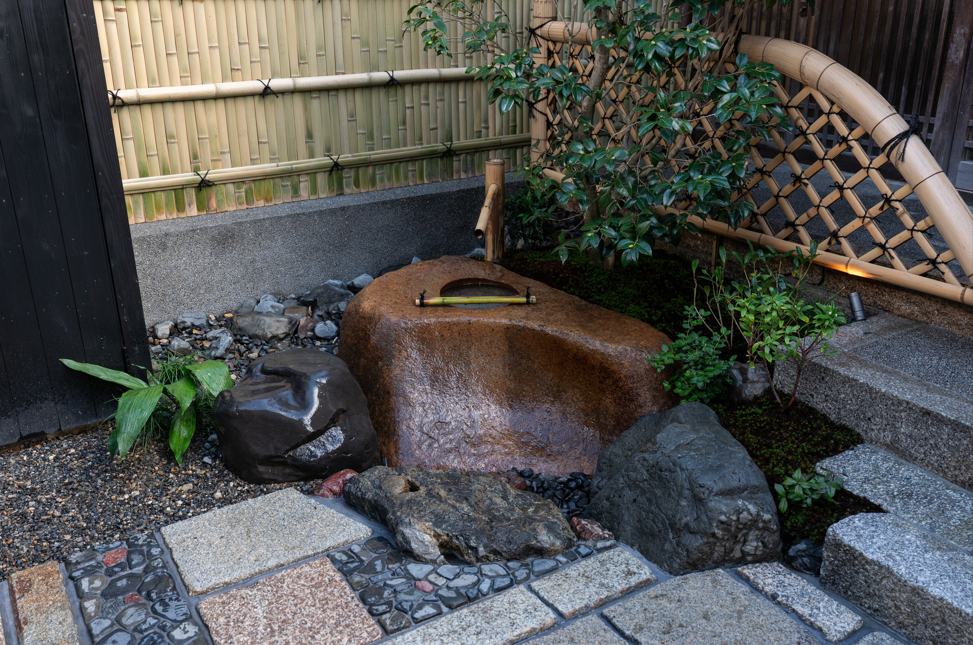
The unity of water and stone. Of the many ways to encapsulate what makes the Japanese garden and its diverse range of expressions unique, this one may be the most succinct. Why do Japanese gardens so prize the harmonization of stone and water? Perhaps it is because the relationship between these two elements is itself an expression of the spiritualization of cleanliness deeply embedded in Japanese culture. If so, the quintessential illustration of this expression may well lie in the basin stone (chozubachi).
In Japan, basin stones are most familiar as presences in Shinto shrines, where visitors use them to cleanse their hands and mouth as a ritual act of purification. That this device—itself an abbreviation of the ancient practice of bathing (misogi) before visiting the gods—first appears in Japanese gardens with the tea garden’s emergence in the sixteenth century suggests a connection between spirituality and sensuality in Japanese gardens that helped this garden form to spread. Alongside stepping stones and stone lanterns, the tsukubai is today one of the tea garden’s most universal elements and a motif that has become synonymous with the Japanese garden itself.
The tsukubai is composed of four key stones, each one of which serves an essential function, but also completes it as part of the garden’s scenery. The basin stone can either be placed at the center of the arrangement (nakabachi) or at its opposite side (mukōbachi). Before the basin stone is the front stone (maeishi) for guests to crouch upon. On either side of the basin stone and the front stone are a candleholder stone (teshoku-ishi), to place a candleholder upon at night, and a hot water vat stone (yuoke-ishi) to place a vat of hot water on during the winter season, when the basin’s water is too cold for guests to use. The arrangement’s center is filled in gravel, often with a few small stones laid down to prevent falling water from splashing back.
The tsukubai’s composition is thus the epitome of functionality. Its hidden genius, however, lies in its ability to affect a feeling of physical transformation at a key moment of transition. The possibility of touching water gives the garden a tactile quality that can be used either subtly or dramatically to alter guests’ state of mind. By the seventeenth century, at Katsura Imperial Villa, there is already an examples of a basin arrangement with a basin stone placed directly inside a water streams (nagare-tsukubai), creating a compositions that blends so imperceptibly into itstheir surroundings that it is easy to miss them. Likewise, stones of the oritsukubai (or “descending basin arrangement”) are dug into the earth so that they descend a slope, thus giving guests’ the sensation of climbing down to the river to wash one’s hands. The tsukubai can even be used as a means of enjoying the sound of water in a garden by filtering the water falling from its basin into an underground jug (suikinkutsu) that resonates as water hits its bottom.
Yet the basin stone is equally powerful as a visual ornament inside the garden. Whether placed at the edge of a temple or teahouse veranda or incorporated into a tsukubai arrangement intended only for visual enjoyment, the basin stone makes it possible to savor the sight of water where otherwise there would be none. In renewing the spirit and refreshing the senses, it translates Japanese spirituality into the sensuality of Japanese gardens.